
The $4.2M Question: What's Actually Running Your Network?


"We've been told we need a full rip-and-replace. But nobody can actually tell us what we have right now."

A $12M Decision Made Without the Facts
The client, a large copper mining operation in the American Southwest, had reached a turning point. Years of incremental network additions, aging hardware, and repeated connectivity failures at critical points across the site had convinced leadership that a complete overhaul was unavoidable. A $12M capital project was on the table. Board approval was weeks away.Before signing off, the operations director asked a question that nobody had a clean answer to: do we actually know what infrastructure we already have, and can any of it be kept?
The honest answer was no. Network diagrams were incomplete and years out of date. Individual teams had added their own connectivity solutions over time, often without coordinating with each other, and rarely documenting what they'd done. Nobody had a reliable view of what existed across the site as a whole. That's when Neeco was brought in, not to design the new network, but to find out what was already there.
What the Survey Revealed
Neeco's field engineers conducted a comprehensive, boots-on-the-ground assessment of the entire site over three weeks. The scope covered approximately 14 miles of underground mine tunnels, roughly half a square mile of above-ground operational space, and several remote facilities located up to three miles from the main operations center.


Access to certain tunnel sections was restricted during blasting windows, which added sequencing constraints to the fieldwork.
Above ground, environmental monitoring stations located between 1.5 and 3 miles from the main facility were still relying on manual data collection: a technician physically driving to each site to retrieve readings. The cost and inefficiency of this approach had been tolerated because nobody had mapped an alternative.
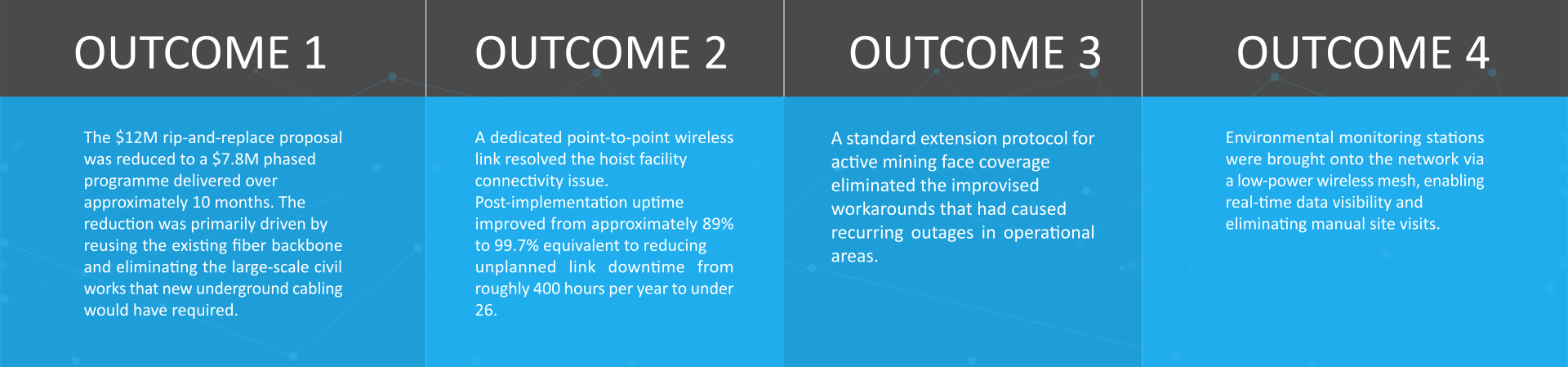
What the fiber assessment found was more encouraging than expected. The backbone cabling running through the main operational areas, single-mode fiber installed during the original mine build, was in better physical condition than the undocumented state of the network had suggested. Connector quality was variable, and some splicing points required remediation, but approximately 70–75% of the backbone was found reusable without replacement. That finding materially changed the cost calculus for the entire modernization programme.
The underground environment presented challenges typical of active mining operations. Repeaters were positioned roughly every 1,000 feet to maintain signal through the tunnels, a standard approach for underground WiFi propagation where tunnel geometry limits any effective line-of-sight beyond that range. Mobile workstations mounted on sled platforms, which advance with the active mining face, each carried their own DSL modem, an elegant field solution that also created a tangle of dependencies that had never been formally documented.
Additional observations highlighted connectivity challenges at remote operational areas. Two hoist facilities positioned across a nearby highway were experiencing intermittent connectivity, largely due to a bluff obstructing a three-mile line-of-sight path from the main operations center.
Documenting these infrastructure elements and physical constraints, helped establish a clearer understanding of how connectivity supports safety systems, monitoring platforms, and day-to-day operational workflows across the site. All survey work was conducted under active mining conditions, requiring close coordination with site safety protocols and shift schedules.

"The problem wasn't the network. It was three specific points where the network had never been properly designed, and years of workarounds had obscured that fact entirely."
Finding the Real Problems
Once the full picture was mapped, the actual sources of operational disruption became clear. They weren't spread across the network, they were concentrated in three places.
First, two hoist facilities positioned across a nearby highway were experiencing persistent intermittent connectivity. The cause: a natural bluff obstructing a three-mile line-of-sight path back to the main operations center. The workaround in place, a single aging wireless link, was inherently unreliable. A properly engineered point-to-point solution had never been scoped because the root cause had never been identified.
Second, the advancing mining face was creating a recurring connectivity gap. As extraction moved deeper, the network infrastructure had to follow, but no standard process existed for extending coverage in a predictable, reliable way. Teams were improvising, which led to inconsistent results and recurring outages in active work areas.
Third, the environmental monitoring stations were entirely off-network by default. Manual data collection was not just inefficient, it introduced safety risk, since real-time environmental data was unavailable to the operations center between scheduled site visits.

None of these were hidden problems. They had all been noticed and complained about. But without a structured assessment, they had never been documented together, traced to their root causes, or costed against the alternative of actually fixing them.
Why Discovery Comes First
The instinct to modernize is often right. The instinct to act before understanding what you have is almost always costly.
In industrial environments, networks rarely follow a single design. They accumulate, shaped by operational necessity, budget cycles, and the decisions of people who have since moved on. The result is infrastructure that works, until it doesn't, in ways that are difficult to predict without a factual baseline.
What this project demonstrated is that a structured field assessment, done properly, with physical verification and not just documentation review, is not a delay to modernization. It is the precondition for doing it well. Without it, investment decisions are made against assumptions. With it, they are made against facts.

The client in this case came to Neeco expecting confirmation that their planned approach was correct. What they received instead was the information they needed to make a significantly better decision.
Neeco provides field-based infrastructure surveys for organizations operating complex industrial, logistics, and enterprise environments where connectivity supports safety systems, operational technology, and monitoring platforms. Survey outputs include physical and logical network mapping, dependency documentation, risk identification, and a prioritized set of recommendations grounded in how the network actually operates, not how it was designed on paper.
Planning a modernization project?
Before scoping new infrastructure, find out what you already have. Neeco conducts field-based assessments across complex industrial and enterprise environments worldwide.